In today’s communication environment, the success of organizations is determined not only by the quality of the products or services they offer. How an organization presents itself, communicates with society, and shapes the impressions of its audience are also of great importance. In this context, brand identity, brand image, and public relations (PR) are closely interconnected concepts.
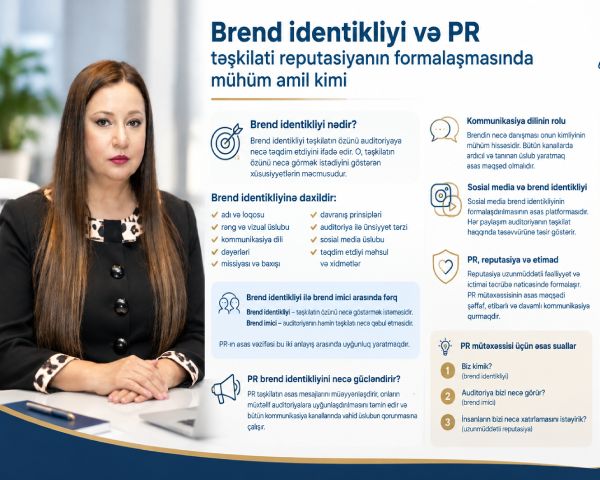
What Is Brand Identity?
Brand identity refers to how an organization presents itself to its audience. In other words, it is a set of characteristics that reflect how a company or institution wants to be perceived by the public.
Brand identity may include:
• the organization’s name and logo;
• its colour palette and visual style;
• its communication language;
• its values;
• its mission and vision;
• its principles of conduct;
• its style of interaction with the audience;
• its social media communication style;
• its products and services.
If we imagine a brand as a person, its identity can be compared to that person’s clothing style, manner of speaking, behaviour, values, and character. Just as individuals present themselves in a particular way to others, organizations use their brand identity to communicate who they are to their audiences.
The Difference Between Brand Identity and Brand Image
One of the most frequently confused concepts in PR is the distinction between brand identity and brand image.
Brand identity is how an organization wants to present itself.
Brand image is how the audience perceives that organization.
For example, a company may position itself as innovative, reliable, and modern. However, customers’ actual experiences, media coverage, social media reviews, and the company’s behaviour may lead the audience to develop an entirely different perception.
For this reason, one of the key objectives of PR is to establish alignment between the identity an organization seeks to create and the image that develops in the minds of its audience.
How Does PR Strengthen Brand Identity?
PR involves the strategic management of an organization’s communication processes. A PR specialist defines the organization’s key messages, ensures that they are adapted to different audiences, and works to maintain a consistent style across all communication channels.
For example, if an organization presents itself as a professional, reliable, and people-oriented institution, these characteristics should be reflected in:
• relationships with the media;
• social media publications;
• management speeches and public statements;
• employees’ public communication activities;
• events;
• advertising and informational materials.
Otherwise, the audience may develop a contradictory perception of the organization.
The Role of Communication Language in Brand Identity
The way a brand communicates is an important part of its personality. Therefore, an organization’s communication language and style should be defined in advance.
For example, some brands use a more formal and corporate tone, while others prefer to communicate with their audiences in a more sincere and emotional manner.
The key is not simply to use attractive expressions, but to establish a consistent and recognizable communication style across all channels.
Although social media posts, press releases, television interviews, and management speeches may differ in format, they should all convey the same underlying brand personality.
Social Media and Brand Identity
In the age of digital communication, social media has become one of the primary platforms for building brand identity.
Every post published on Facebook, Instagram, LinkedIn, YouTube, TikTok, and other platforms influences how audiences perceive an organization.
Therefore, when developing a social media strategy, it is important to focus not only on the number of publications but also on the following aspects:
• visual consistency;
• writing style;
• consistency of key messages;
• audience expectations;
• content quality;
• presentation of the organization’s expertise;
• responses to comments and questions;
• communication during crises.
Thus, social media is not merely a tool for sharing information. It is a communication environment in which an organization demonstrates its brand identity every day.
PR, Reputation, and Trust
While brand identity reflects how an organization presents itself, reputation develops over time as a result of its activities and the public’s experiences and interactions with it.
Reputation is not built overnight. It gradually takes shape through the organization’s promises, actual performance, customer experiences, employee behaviour, media relations, and communication with the public.
In this regard, the work of a PR specialist involves more than simply disseminating positive news. The main objective is to establish transparent, reliable, and sustainable communication between the organization and the public.
Key Takeaways for PR Specialists
A PR specialist is one of the key communication professionals responsible for shaping a brand’s voice, behaviour, and relationships with the public.
To develop an effective PR strategy, it is important to answer three questions:
Who are we?
This question defines brand identity.
How does our audience perceive us?
This question relates to brand image and public perception.
How do we want people to remember us?
This question forms the foundation of a long-term reputation management strategy.
In conclusion, a strong brand identity goes beyond visual appearance. It is an integrated system that brings together an organization’s values, behaviour, communication style, and relationships with its audience.
One of the main responsibilities of a PR specialist is to ensure that this system is maintained consistently across all communication channels and to establish a reliable connection between the image an organization seeks to create and the way it is actually perceived by the public.
Thus, brand identity reflects how an organization presents itself, PR determines how that identity is communicated to society, and reputation represents the overall perception of the organization that develops over the long term as a result of these efforts.
Dilara Zamanova
PR Specialist at the Central Customs Hospital